
-
Book your visit now.
Write to us here. -





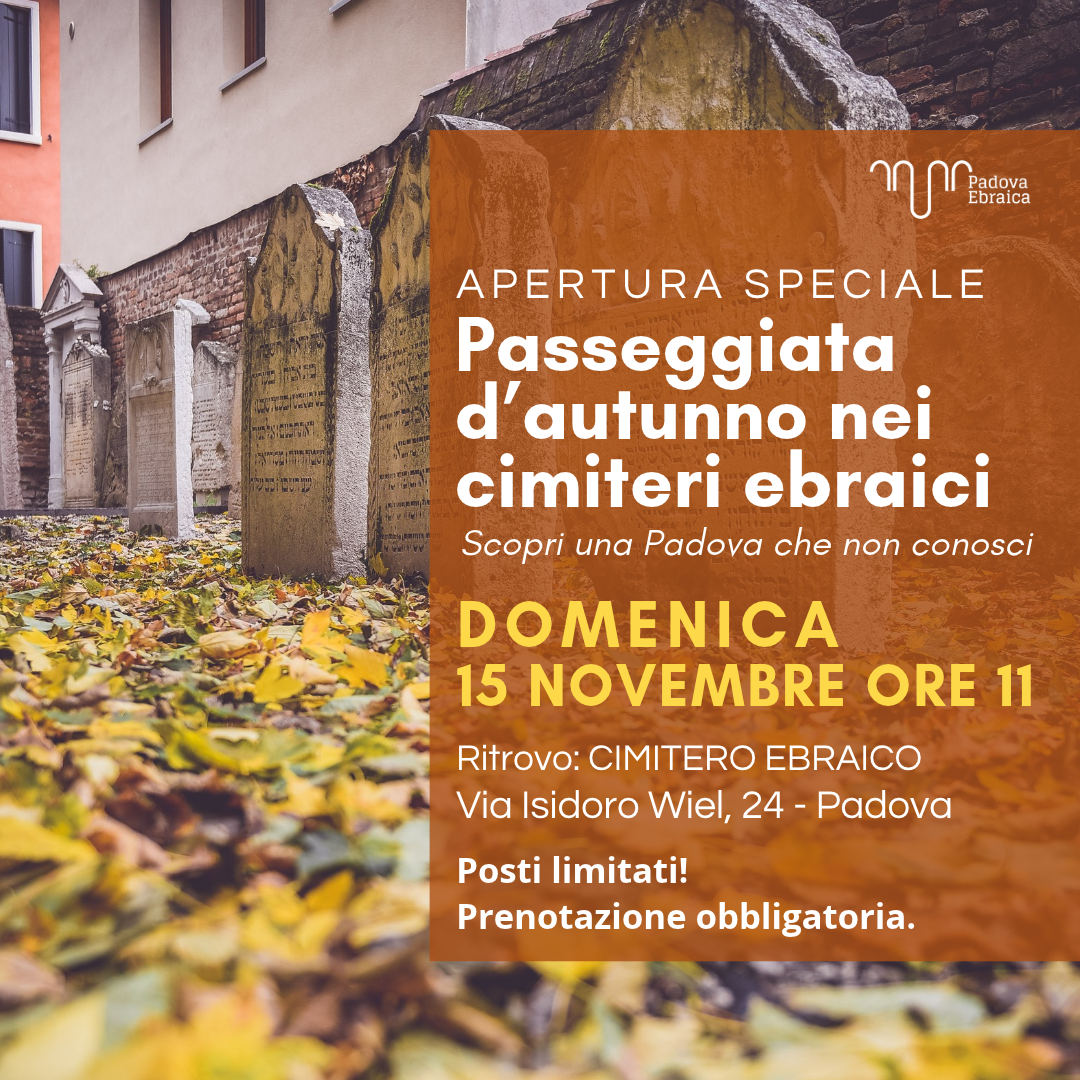
On Sunday 15 November 2026 at 11.00 a.m., join us on a special autumn walk to discover Padua’s three ancient Jewish cemeteries, which are among the city’s most fascinating and least well-known sites.
A guided tour in the open air, amidst the colours of autumn, which will take us on a journey through almost eight centuries of history, culture and memory.
Amidst ancient gravestones, trees with yellowing leaves and traces of the past, we shall discover the history of Padua’s Jewish community through the stories of rabbis, doctors, intellectuals and prominent figures who have left their mark on the life of the city.
The experience will also be enriched by “Racconti di Pietra” 🎧, the podcast that gives a voice to the places and key figures of Padua’s Jewish history, transforming memory into a compelling and moving narrative.
🍁 A special opportunity to experience the beauty of autumn, take a stroll through history and discover a side of Padua you may not yet know.
📌 Duration: approximately 1 hour and 30 minutes
✅ Booking required – PLACES ARE LIMITED!
🎩 Appropriate attire is recommended, and men are kindly requested to wear a hat.
Let yourself be captivated by the colours of autumn and the stories these places hold.
WE LOOK FORWARD TO SEEING YOU!
Book your place NOW!
The Synagogue
of Italian rite
The Italian rite Synagogue is undoubtedly among the must-visit places in Padua. Founded in 1548, still in use, embellished with elegant eighteenth-century furnishings.
Guided Tour
and multimedia experience
Guided tours to accompany you in the visit of the Museum, Italian Synagogue, and the ancient Jewish Cemeteries of the city. The arches of the matroneum become a canvas for an immersive multimedia experience.

Presented at the ticket office of the Eremitani Museum you will be entitled to a reduction on the entrance ticket to the Civic Museums of Padua
Sunday 15 NOVEMBER 2026 |
at 11 a.m.
Old Jewish Cemetery in via Wiel
Via Isidoro Wiel, 24
Padua (PD)
Please arrive at the entrance 5 minutes before the scheduled time.
Discounts are available for families and people with disabilities.
Booking required!

A very old story is narrated through these narrow and restricted streets: the story of the Jewish settlement, its commercial, social, cultural and religious past.
Four gates closed the Ghetto: a sign on one of them forbade Jews as well as Christians to go through the gates at night.

The Italian Synagogue (1548) is still the prayer site for the members of the Community of Padua. The hall is marked out by the elegant and refined “marmorino” decorations and delicate stucco works dating back to neoclassic times.
The Aron Kodesh, made of polychrome marbles, on the eastern wall faces the Bimah, crafted from wood of a century-old tree felled by a storm in the Botanical Garden of the city.

In the heart of the historic center of Padua and in the ancient ghetto stands the museum that tells the history and traditions of the local Jewish Community, from its inception to the present day.
The structure is housed in the first and largest Ashkenazi Synagogue, founded in 1522 and remained active until May 1943, when it was set on fire by a group of Paduan fascists.

Within the museum, visitors can experience a multimedia journey thanks to the immersive video installation by director Denis Brotto, which allows them to delve into the lives of ten prominent figures from the history of the Paduan Jewish community
You can dive into the life of ten illustrious characters of Padua Jewish life. The characters come to life to narrate their stories through the places representing Padua Judaism.

The Stumbling Stones, laid in the pavement in memory of the victims of Nazi-Fascism, many of which are also visible in the 'ghetto'
In front of the victim's last residence stands a block of stone covered with a brass plate engraved with the name of the deported person, year of birth, date, place of deportation, and, if known, the date of death.

Founded in 1384, the cemetery located along Via Wiel represents one of the four Jewish cemeteries still present in the city of Padua. This ancient sacred place retains its historical significance intact and hosts the tombs of prominent figures of the local Jewish community.
Among these stand out Rabbi Meir Katzenellenbogen (Maharam), his son Samuel Judah Katzenellenbogen, as well as the doctors Abram Catalan and Moshe David Valle.
For reservations or information, fill out the form and we will be happy to respond
For reservations or information, fill out the form and we will be happy to respond
Book your visit now.
Write to us here.
