
-
Book your visit now.
Write to us here. -





The initiative ‘Polishing the Memory: public clean-up and guided tour of Padua’s Stumbling Stones’, organised by the Museum of Jewish Padua, offers a series of two free events comprising a guided tour of the Stumbling Stones laid throughout the city and a collective polishing session.
The ‘Stumbling Stones’ memorial, created by the artist Gunter Demnig to keep alive the memory of the victims of Nazi-Fascism, will serve as the setting for a guided tour led by qualified staff from the Museum of Jewish Padua, designed to explore the historical dynamics underlying the discrimination and persecution suffered between 1938 and 1945 by Jews and all other victims of the Holocaust, to understand the characteristics of this landmark monument and learn about the stories it holds, to consolidate the historical memory built up to date and to highlight it through the tangible act of cleaning the Stumbling Stones.
The initiative aims to promote historical understanding and the preservation of the memory of the Holocaust, as well as, more generally, to encourage the fight against all forms of racial and anti-Semitic discrimination, and to promote inclusion and diversity in terms of culture, ethnicity, gender, background and religion.
Each visit will consist of a walking tour in stages, taking participants through the city and recounting the stories of the people commemorated by the Stones. Participants will also take turns to help with the cleaning, so that the experience becomes even more engaging and serves as an act of care and shared responsibility towards the city and its public spaces.
1) Sunday 25 October, 11.00 am: tour and cleaning of the Stumbling Stones in Via Prati, Via Barbarigo, Via Roma, Via VIII Febbraio, Via Damiano Chiesa and Piazza del Santo (17 Stumbling Stones)
2) Sunday 29 November, 11.00 am: tour and cleaning of the Stumbling Stones in Via Calatafimi and Via Petrarca (6 stones).
Each tour will last approximately 2 hours and 30 minutes and is suitable for all ages.
EVENTS WITH FREE ADMISSION BUT WHERE BOOKING IS REQUIRED
museo@padovaebraica.it tel. +39 049661267 Whatsapp +39 3762256076

The Synagogue
of Italian rite
The Italian rite Synagogue is undoubtedly among the must-visit places in Padua. Founded in 1548, still in use, embellished with elegant eighteenth-century furnishings.
Guided Tour
and multimedia experience
Guided tours to accompany you in the visit of the Museum, Italian Synagogue, and the ancient Jewish Cemeteries of the city. The arches of the matroneum become a canvas for an immersive multimedia experience.

Presented at the ticket office of the Eremitani Museum you will be entitled to a reduction on the entrance ticket to the Civic Museums of Padua
Sunday 25 OCTOBER
Sunday 29 NOVEMBER
Museum of Jewish Padua
Via delle Piazze, 26 – 35122 Padua
Approximately 2 hours 30 minutes
EVENTS WITH FREE ADMISSION BUT WHERE BOOKING IS REQUIRED
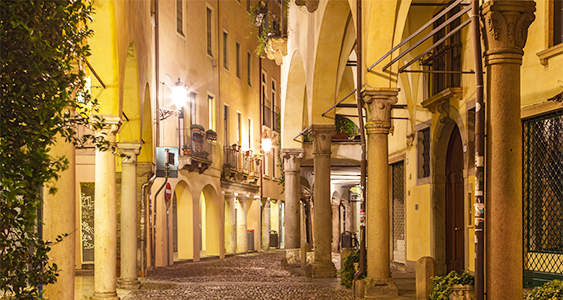
A very old story is narrated through these narrow and restricted streets: the story of the Jewish settlement, its commercial, social, cultural and religious past.
Four gates closed the Ghetto: a sign on one of them forbade Jews as well as Christians to go through the gates at night.
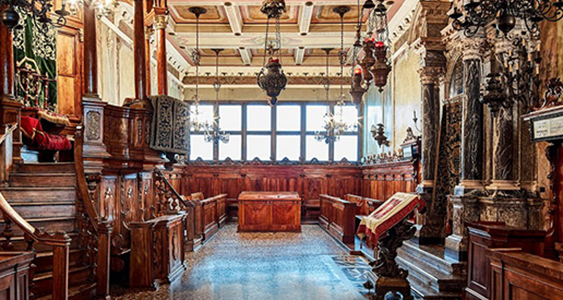
The Italian Synagogue (1548) is still the prayer site for the members of the Community of Padua. The hall is marked out by the elegant and refined “marmorino” decorations and delicate stucco works dating back to neoclassic times.
The Aron Kodesh, made of polychrome marbles, on the eastern wall faces the Bimah, crafted from wood of a century-old tree felled by a storm in the Botanical Garden of the city.
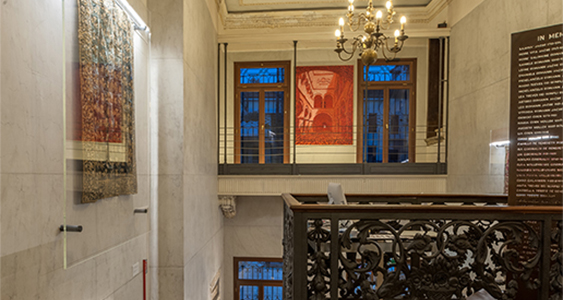
In the heart of the historic center of Padua and in the ancient ghetto stands the museum that tells the history and traditions of the local Jewish Community, from its inception to the present day.
The structure is housed in the first and largest Ashkenazi Synagogue, founded in 1522 and remained active until May 1943, when it was set on fire by a group of Paduan fascists.
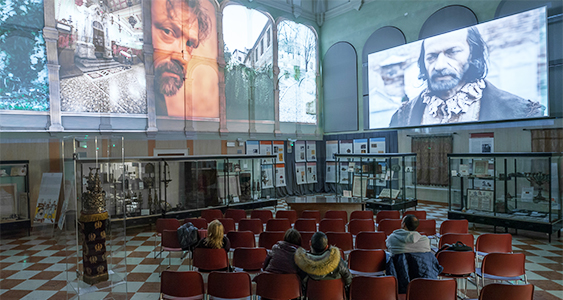
Within the museum, visitors can experience a multimedia journey thanks to the immersive video installation by director Denis Brotto, which allows them to delve into the lives of ten prominent figures from the history of the Paduan Jewish community
You can dive into the life of ten illustrious characters of Padua Jewish life. The characters come to life to narrate their stories through the places representing Padua Judaism.
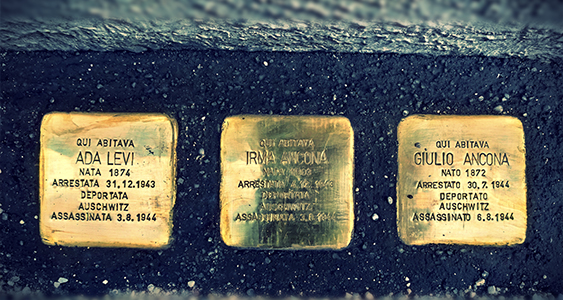
The Stumbling Stones, laid in the pavement in memory of the victims of Nazi-Fascism, many of which are also visible in the 'ghetto'
In front of the victim's last residence stands a block of stone covered with a brass plate engraved with the name of the deported person, year of birth, date, place of deportation, and, if known, the date of death.
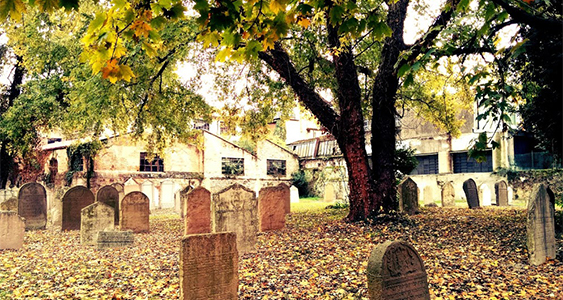
Founded in 1384, the cemetery located along Via Wiel represents one of the four Jewish cemeteries still present in the city of Padua. This ancient sacred place retains its historical significance intact and hosts the tombs of prominent figures of the local Jewish community.
Among these stand out Rabbi Meir Katzenellenbogen (Maharam), his son Samuel Judah Katzenellenbogen, as well as the doctors Abram Catalan and Moshe David Valle.
For reservations or information, fill out the form and we will be happy to respond
For reservations or information, fill out the form and we will be happy to respond
Book your visit now.
Write to us here.
